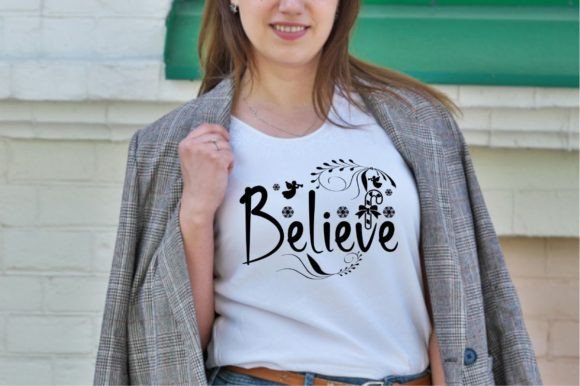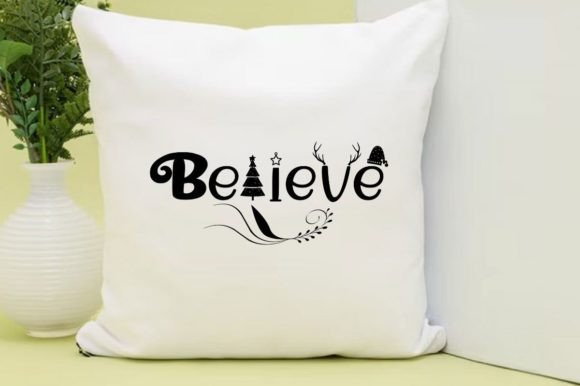
BELIEVE, SVG: Bold Graphics for T-Shirt Designs & Brand Projects
As a graphic designer who’s built brand identities for handmade businesses, launched seasonal print-on-demand collections, and crafted social media graphics for Etsy sellers, I opened BELIEVE, SVG expecting a simple motivational phrase — but what landed in my workspace was a surprisingly versatile creative design. I reviewed it not as stock art, but as a potential component of a real client project: a small-batch wellness brand launching a spring “mindful movement” capsule collection (think organic cotton tees, ceramic mugs, and minimalist wall prints). Here’s how BELIEVE, SVG held up under professional scrutiny.
A First Impression That Sets the Tone
The design immediately reads as warm, grounded, and quietly confident — not shouty or overly decorative. It uses clean vector lines, balanced letter spacing, and subtle weight variation that suggests hand-drawn intention without sacrificing scalability. There’s no extraneous ornamentation, yet it carries emotional resonance. That makes it ideal for brands leaning into authenticity: yoga studios, herbal apothecaries, indie bookshops, or local event campaigns where sincerity matters more than slickness.
Where BELIEVE, SVG Excels in Real Client Work
This graphic design asset shines when applied across multiple touchpoints with consistency. In our wellness brand mockup, it anchored t-shirt designs without overwhelming the fabric’s texture. On ceramic mugs, it scaled cleanly at 3" diameter — no pixelation, no jagged edges. As a sticker design for reusable water bottles? Perfectly legible at 2". As part of a Canva template for Instagram posts, it paired effortlessly with sans serif body text and earth-toned gradients.
- Product mockups: Works beautifully on tee mockups (especially logo sleeve tees and relaxed-fit tanks), tote bags, and pillow covers — its proportions hold up in both centered and asymmetrical placements.
- Packaging design: Used subtly on kraft paper product labels and tissue wrap, it added warmth without competing with product photography.
- Social media graphics: Served as a hero visual in Pinterest pins and Instagram carousels — high contrast, fast recognition, strong emotional hook.
- Cricut projects: Cut flawlessly on vinyl and iron-on material; no inner joins or overlapping paths to complicate weeding.
- Printable design: Printed crisply at A4 and 12"x12" sizes for wall art — no color banding or transparency issues in the SVG or included PNG files.
Strategic Uses Beyond the Obvious
While marketed as a t-shirt design, BELIEVE, SVG functions powerfully as a supporting brand element. We used it as a watermark-style accent in editorial design for the client’s digital newsletter, layered softly behind body copy. It doubled as a sublimation design for custom blankets — retaining clarity even across large-format heat transfer. In a blog post about mindful habits, it became a recurring visual motif in section dividers and pull-quote highlights, reinforcing brand identity without repetition fatigue.
Where to Proceed With Intention
This isn’t a one-size-fits-all asset. It loses impact below 1.25" height — avoid using it as tiny web icons or app favicons. On busy, high-contrast backgrounds (like camo-print fabric or textured concrete photos), test legibility rigorously. It doesn’t pair well with ultra-minimalist corporate branding — think law firms or fintech startups — where neutrality and restraint are non-negotiable. Also, skip pairing it with delicate script fonts or tight serif typography; it needs breathing room and complementary weight.
Designer Notes You Can’t Skip Before Client Use
Before dropping BELIEVE, SVG into a commercial design, run these checks:
- Test in grayscale: Confirm it retains hierarchy and presence without color — critical for embroidery or single-color screen printing.
- Check contrast on light AND dark backgrounds: Verify readability against white, black, oat, and sage — especially for packaging and web design.
- Preview at actual output sizes: Zoom out to 25% in Illustrator to simulate large-format print; zoom in to 400% to spot path imperfections.
- Place on real mockups: Not just flat previews — use layered PSDs or Smart Objects to see how it interacts with fabric grain, mug curvature, or sticker gloss.
- Confirm commercial license scope: Does it cover print-on-demand, digital resale (e.g., Canva templates), and physical product labeling? Always verify — this is non-negotiable for client work.
- Inspect file integrity: Open the SVG in a vector editor — check for hidden layers, raster elements, or ungrouped compound paths that could break scaling or editing.
- Compare font pairings: Try it beside Montserrat, Playfair Display, and handwritten options like Pacifico — note which supports brand voice without visual tension.
Why This Belongs in Your Design Toolkit
BELIEVE, SVG isn’t just another clipart download. It’s a thoughtfully constructed digital product that bridges emotional appeal and technical reliability. For small business branding, it delivers instant warmth and memorability. For crafters and Cricut users, it’s production-ready. For marketers building cohesive campaigns, it scales across formats without rework. And for designers managing visual hierarchy across merch, web, and print — it earns its place as a trusted, repeatable element.
If your next project centers on authenticity, quiet confidence, or community-driven storytelling — whether it’s an Etsy product launch, a local festival campaign, or a handmade business rebrand — BELIEVE, SVG isn’t just usable. It’s purpose-built.